International Journal of Research and Development in Engineering Sciences

International Journal of Research and Development in Engineering Sciences

Scholarly Peer Reviewed and Fully Referred Open Access Multidisciplinary Quarterly Research Journal

  • ISSN (Online): 2582 - 4201
  • ESTD: 2019
  • IJRDES
  • DOI : 10.63328/ijrdes
  • ijrdes@jacksparrowpublisher.com
Jack Sparrow Publishers
Register Login
 
  • Home
  • About Journal
    • About Us
    • Privacy Policy
    • Aim & Scope
    • Open Access
    • Contact Us
  • Editorial Board
    • Editorial Board Members
    • Journal Review Process
    • Copyright & Plagiarism Policy
    • Digital Library
    • Ethics & Disclosure
  • Submit Paper
    • Paper Submission
    • Author Guidelines
    • Publication Ethics & Malpractice Statement
    • How to Publish with Us
  • Indexing
  • Impact Factor
  • Archieves
    • Current Issue
    • Archieves
  • Conferences
  • APC
New / Update: Call For Papers : Volume 3 , Issue 5
Menu ×
  • Home
  • About Journal
    • About Us
    • Privacy Policy
    • Aim & Scope
    • Open Access
    • Contact Us
  • Editorial Board
    • Editorial Board Members
    • Journal Review Process
    • Copyright & Plagiarism Policy
    • Digital Library
    • Ethics & Disclosure
  • Submit Paper
    • Paper Submission
    • Author Guidelines
    • Publication Ethics & Malpractice Statement
    • How to Publish with Us
  • Indexing
  • Impact Factor
  • Archieves
    • Current Issue
    • Archieves
  • Conferences
  • APC
CURRENT ISSUE: Volume 8(2026) Issue 5 (September - October)
Comparative Analysis of Quantum Machine Learning Algorithms: Variational Quantum Classifiers, Quantum Support Vector Machines, and Hybrid Quantum-Classical Networks
Editorial
Comparative Analysis of Quantum Machine Learning Algorithms: Variational Quantum Classifiers, Quantum Support Vector Machines, and Hybrid Quantum-Classical Networks

Jampana Usha Rani , Kondapalli Venkata Ramana

  • Pages:pp.18 - 29
  • DOI:https://doi.org/10.63328/IJRDES-V8RI5P3DOI
  • Downloads:39
  • Views:181
  • Abstract
  • Download
  • XML
  • EPUB
  • Video
  • Audio
  • Citation
  • Certificate

Abstract

Quantum machine learning (QML) aims to use quantum-in-the-knowledge resources to improve learning performances. How current out-of-the-box algorithms compare with carefully optimized classical algorithms is unclear at present. We compare QML paradigms all quantum models run on a noise-free state vector simulator (Qiskit Aer) against three classical baselines: a kernel SVM, Random Forest and XGBoost. The three QML models are (i) the Variational Quantum Classifier (VQC), (ii) a quantum-optimized support vector machine (QSVM) and (iii) a hybrid quantum-classical Multi-Layer Perceptron (HQ-MLP). Quantum models are trained on subsets of the binary MNIST dataset (digits 0 vs. 1, PCA-reduced to between 4 and 8 features) and tested on the remaining data. In addition, we use four synthetic, two-class benchmark problems: circles, moons, a multi-cluster data set, and spirals. Accuracy, the area under the ROC curve (AUC), training time and prediction time are reported for each. On the MNIST dataset, the quantum and hybrid models reach 97.50–98.33% accuracy, within one percentage point of the classical models (99.33%). On the synthetic data sets, quantum and hybrid models perform similarly (94.00–96.25%) to classical SVM and XGBoost (92.50%) but less well than Random Forest (100%). The HQ-MLP attains the highest accuracy among the quantum models at near-classical cost, with VQC and QSVM requiring approximately one to two orders of magnitude longer to train and more than an order of magnitude longer to infer at in. Simulation. We explain why these outcomes should not be taken as evidence for quantum advantage, examine threats to validity and enumerate the experiments needed to demonstrate it.

Keywords : QML, VQC, quantum support vector machine, QSVM, NISQ, MNIST, benchmarking.

Authors : Jampana Usha Rani , Kondapalli Venkata Ramana

Title : Comparative Analysis of Quantum Machine Learning Algorithms: Variational Quantum Classifiers, Quantum Support Vector Machines, and Hybrid Quantum-Classical Networks

Volume/Issue : 2026;8(5 (September - October))

Page No : 18 - 29

Audio

Comparative Analysis of Quantum Machine Learning Algorithms: Variational Quantum Classifiers, Quantum Support Vector Machines, and Hybrid Quantum-Classical Networks

Citation
Jampana Usha Rani , Kondapalli Venkata Ramana , " Comparative Analysis of Quantum Machine Learning Algorithms: Variational Quantum Classifiers, Quantum Support Vector Machines, and Hybrid Quantum-Classical Networks " , International Journal of Research and Development in Engineering Sciences (IJRDES), Volume 8, Issue 5 , pp 18 - 29 , October 2026. CrossRef DOI: https://doi.org/10.63328/ijrdes-v8ri5p3
Integrating LSTM and Flutter For Real-Time Solar DC Power Prediction
Original Article
Integrating LSTM and Flutter For Real-Time Solar DC Power Prediction

Chigilipalli Bharat Kumar

  • Pages:pp.8 - 17
  • DOI:https://doi.org/10.63328/IJRDES-V8RI5P2DOI
  • Downloads:31
  • Views:115
  • Abstract
  • Download
  • XML
  • EPUB
  • Video
  • Audio
  • Citation
  • Certificate

Abstract

Renewable energy sources, particularly solar energy, are essential to meeting the world's growing energy needs. Real-time prediction of DC power generation is necessary for optimizing energy management and utilization of solar energy. We initially used regression models like Linear Regression, XGBoost, MLP Regressor, and Random Forest to predict DC power directly. While these models showed good accuracy, they were not ideal for time-series forecasting. To eliminate this limitation, we subsequently employed deep learning models LSTM, 1D CNN, and GRU to predict key features like AC frequency, AC voltage, DC link voltage, energy today, output current, total energy, output power, DC, pyranometer reading, temperature, and power factor based on date and time as input. These forecasted features were further used to predict the target variable, DC Power. The LSTM model most accurately predicted the intermediate features and the end DC power output among the deep learning models. Our LSTM network was trained on real data and achieved a Root Mean Squared Error (RMSE) of 0.039, a Mean Absolute Error (MAE) of 0.020, and an R² score of 0.909, indicating high prediction accuracy.

Keywords : Solar Energy Prediction, LSTM, Time Series Forecasting, DL , Renewable Energy Management.

Authors : Chigilipalli Bharat Kumar

Title : Integrating LSTM and Flutter For Real-Time Solar DC Power Prediction

Volume/Issue : 2026;8(5 (September - October))

Page No : 8 - 17

Audio

Integrating LSTM and Flutter For Real-Time Solar DC Power Prediction

Citation
Chigilipalli Bharat Kumar , " Integrating LSTM and Flutter For Real-Time Solar DC Power Prediction " , International Journal of Research and Development in Engineering Sciences (IJRDES), Volume 8, Issue 5 , pp 8 - 17 , October 2026. CrossRef DOI: https://doi.org/10.63328/ijrdes-v8ri5p2
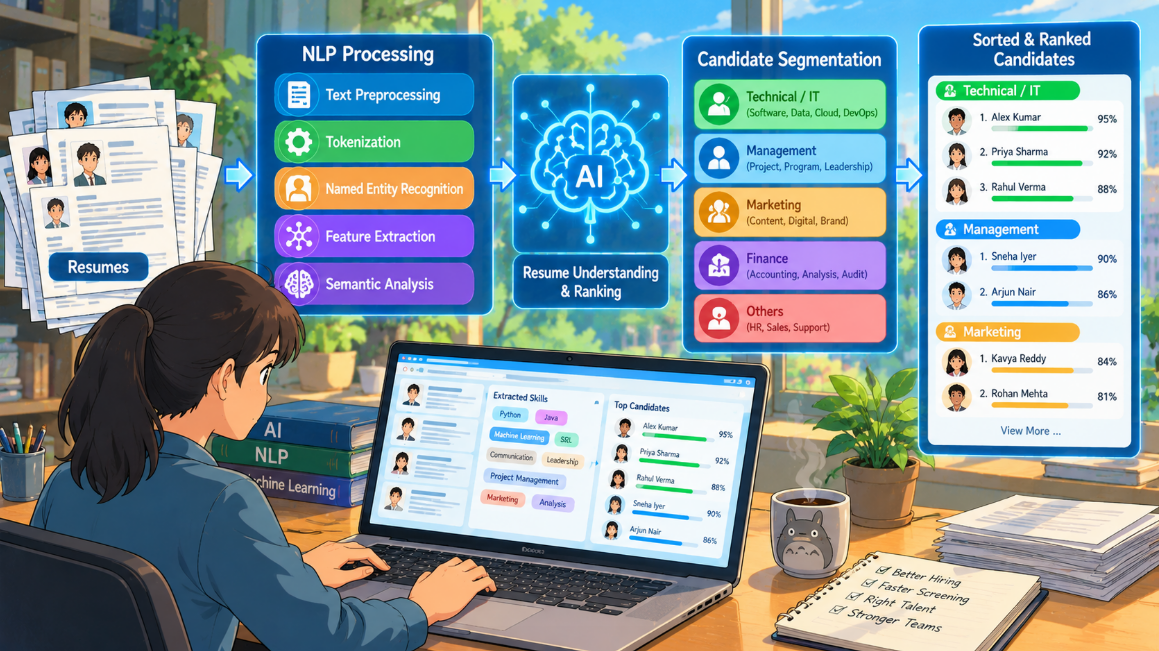
Automated Resume Screening  And Segmentation Using Natural Language Processing
Original Article
Automated Resume Screening And Segmentation Using Natural Language Processing

Peethala Sowjanya Yamini , D. Lalitha Bhaskari

  • Pages:pp.1 - 7
  • DOI:https://doi.org/10.63328/IJRDES-V8RI5P1DOI
  • Downloads:25
  • Views:101
  • Abstract
  • Download
  • XML
  • EPUB
  • Video
  • Audio
  • Citation
  • Certificate

Abstract

An AI-based system designed to simplify and improve the recruitment process through Artificial Intelligence and Natural Language Processing (NLP) techniques. The system automatically extracts information from PDF resumes and compares it with a job description to identify the most suitable candidates. It uses Term Frequency-Inverse Document Frequency (TF-IDF) for keyword extraction, Sentence-BERT (SBERT) for semantic similarity analysis, and Applicant Tracking System (ATS) scoring for keyword-based evaluation. A weighted scoring mechanism combines these measures to generate a final candidate score and rank applicants accordingly. The system further segments resume content into sections such as skills, education, experience, projects, and certifications, and includes an Explainable AI module that highlights missing skills and gives transparent reasons for each candidate score. An AI Resume Suggestion module recommends improvements to resume quality and ATS compatibility, while a Resume Quality Checker verifies the completeness of essential details such as contact information, skills, projects, LinkedIn, GitHub, and certifications. A classification model further predicts the most suitable job role from resume content. All outputs are presented through an interactive Streamlit dashboard showing candidate rankings, performance metrics, and graphical visualizations. The prototype was implemented using Python, Streamlit, spaCy, Sentence-Transformers, Scikit-learn, Pandas, NumPy, Matplotlib, and pdf plumber, and testing confirms that it reduces manual screening effort, improves ranking accuracy over keyword-only ATS filtering, and supports fair, transparent, and data-driven hiring decisions.

Keywords : NLP, TF-IDF, Sentence-BERT, Applicant Tracking System, Explainable AI, Job Role Prediction.

Authors : Peethala Sowjanya Yamini , D. Lalitha Bhaskari

Title : Automated Resume Screening And Segmentation Using Natural Language Processing

Volume/Issue : 2026;8(5 (September - October))

Page No : 1 - 7

Audio

Automated Resume Screening And Segmentation Using Natural Language Processing

Citation
Peethala Sowjanya Yamini , D. Lalitha Bhaskari , " Automated Resume Screening And Segmentation Using Natural Language Processing " , International Journal of Research and Development in Engineering Sciences (IJRDES), Volume 8, Issue 5 , pp 1 - 7 , September 2026. CrossRef DOI: https://doi.org/10.63328/ijrdes-v8ri5p1
Submit Manuscript Fast, peer-reviewed publication

Manuscript Status

Enter the number from your submission e-mail to see its current review stage.

Cover Page

Journal cover page 1
Journal cover page 2
Journal cover page 3
Journal cover page 4
Journal cover page 5

Archives

  • Issue 1 (January - February) 5 papers
  • Issue 2 (March - April) 5 papers
  • Issue 3 (May - June) 3 papers
  • Issue 4 (July - September) 3 papers
  • Issue 5 (September - October) 3 papers
  • Issue 1 (January - February) 9 papers
  • Issue 2 (March - April) 9 papers
  • Issue 3 (May - June) 10 papers
  • Issue 4 (July - August) 9 papers
  • Issue 5 (September - October) 9 papers
  • Issue 6 (November - December) 10 papers
  • Issue 1 (January - February) 5 papers
  • Issue 2 (March - April) 9 papers
  • Issue 3 (May - June) 6 papers
  • Issue 4 (July - August) 6 papers
  • Issue 5 (September - October) 1 papers
  • Issue 6 (November - December) 8 papers
  • Issue 1 (January - February) 5 papers
  • Issue 2 (March - April) 5 papers
  • Issue 3 (May - June) 5 papers
  • Issue 4 (June - July) 4 papers
  • Issue 5 (September - October) 3 papers
  • Issue 6 (November - December) 4 papers
  • Issue 1 (January - February) 1 papers
  • Issue 2 (March - April) 1 papers
  • Issue 3 (May - June) 5 papers
  • Issue 4 (July - August) 1 papers
  • Issue 5 (September - October) 1 papers
  • Issue 6 (November - December) 1 papers
  • Issue 1 (January - February) 2 papers
  • Issue 2 (March - April) 3 papers
  • Issue 3 (May - June) 2 papers
  • Issue 4 (August - September) 6 papers
  • Issue 5 (September - October) 2 papers
  • Issue 6 (November - December) 1 papers
  • Issue 1 (January - February) 4 papers
  • Issue 2 (March - April) 4 papers
  • Issue 3 (May - June) 10 papers
  • Issue 4 (July - August) 5 papers
  • Issue 5 (September - October) 1 papers
  • Issue 6 (November - December) 5 papers
  • Issue 1 (November - December) 7 papers
All archives
IJRDES International Journal of Research and Development in Engineering Sciences

Scholarly peer reviewed and fully referred open access multidisciplinary quarterly research journal.

  • ISSN (Online): 2582 - 4201
  • DOI : 10.63328/ijrdes
  • ijrdes@jacksparrowpublisher.com

Quick Links

  • Indexing
  • Impact Factor
  • Conferences
  • APC

Connect with us

  • Facebook
  • Twitter
  • LinkedIn
Login / Register

Partner With us

Partner
Partner
Partner
Partner
Partner
View All

Copyright © 2026 IJRDES. All Rights Reserved | Jack Sparrow Publishers

page visitor counter